
Founded 1999 in Germany, Round Solutions is one of the leading pioneers in M2M and IoT technologies. We design, build and distribute the world's most advanced Edge and wireless technologies.

RoundSolutions © 2025 For A Wireless World


Industrial IoT deployments require reliable, long-range, and energy-efficient wireless communication. Traditional Wi-Fi (2.4 GHz / 5 GHz) often lacks sufficient range and penetration, while LPWAN technologies may not support full IP networking or higher data throughput.
Wi-Fi HaLow (IEEE 802.11ah) operates in the sub-GHz frequency band and bridges this gap. It combines extended range, strong wall penetration, native IP support, and scalable network architecture — making it a powerful solution for industrial edge deployments.
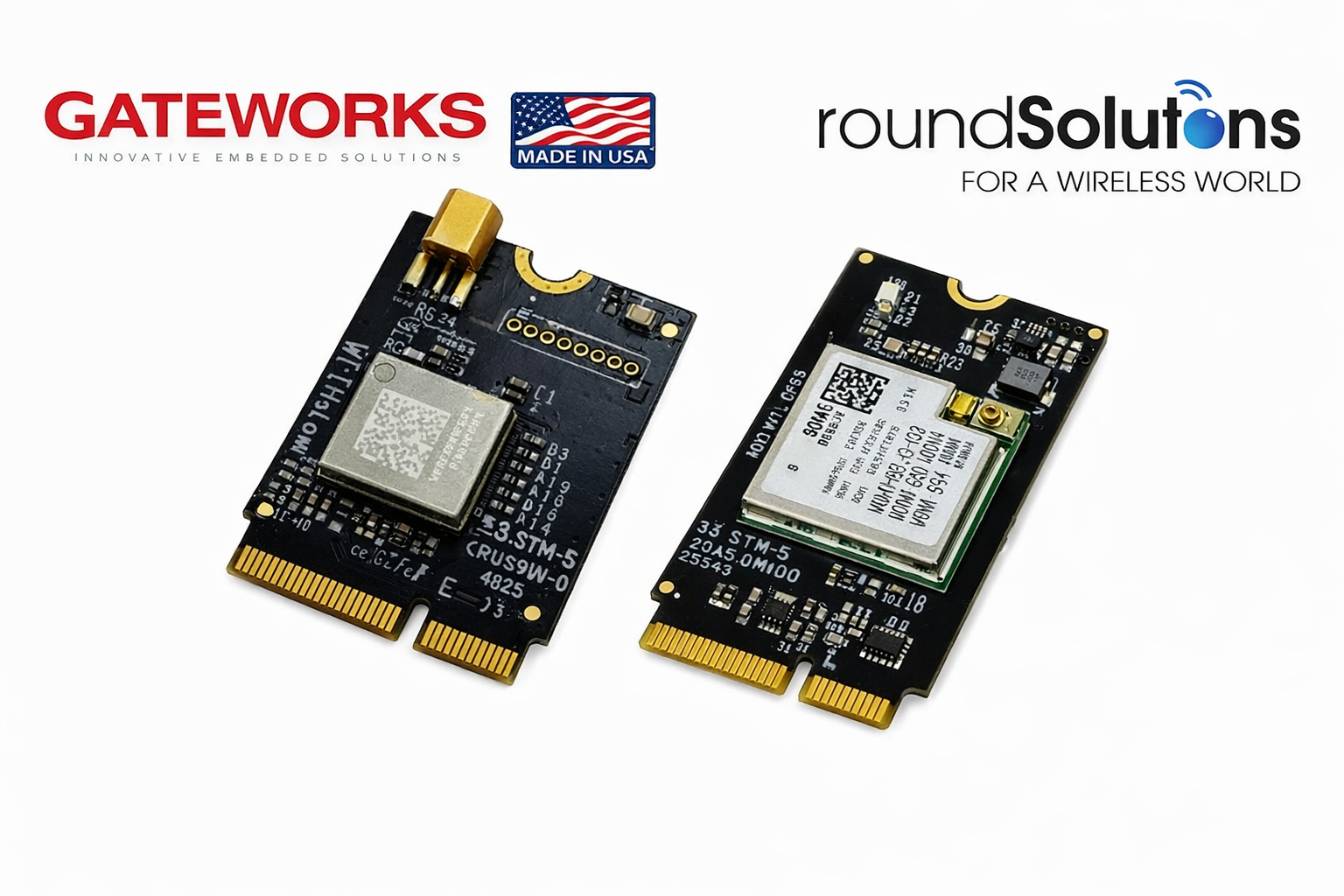
This whitepaper explains the technology behind HaLow, its advantages over traditional wireless standards, and how industrial-grade modules such as GW16159 and GW16167 enable robust IoT infrastructure.
Wi-Fi HaLow is an extension of the IEEE 802.11 family operating in sub-GHz frequency bands (typically 850–950 MHz depending on region). Compared to 2.4 GHz Wi-Fi, the lower frequency provides:
Unlike LPWAN solutions, HaLow supports native IP networking, enabling direct integration into existing IT infrastructures without protocol translation.
Lower frequencies travel farther and penetrate obstacles more effectively.
In industrial environments such as factories, warehouses, energy facilities, and smart infrastructure projects, radio signals must pass through:
Sub-GHz communication reduces attenuation and improves reliability, reducing the number of access points required.
Result: Lower infrastructure cost and higher system stability.
HaLow combines the range advantage of LPWAN with the networking flexibility of Wi-Fi.
Wi-Fi HaLow is well suited for:
Its ability to maintain stable connectivity across large industrial areas makes it ideal for edge computing architectures.
Designed for tight integration into Gateworks VeniceFLEX industrial single-board computers.
Built around the Morse Micro MM8108 chipset, enabling next-generation long-range performance with flexible integration into Gateworks industrial SBC platforms.
In a typical deployment:
Sensors → HaLow Node → Gateworks SBC → Edge Processing → Secure Cloud Connection
HaLow enables:
When combined with industrial single-board computers, HaLow becomes part of a scalable edge computing framework.
Wi-Fi HaLow supports standard Wi-Fi security mechanisms including WPA3.
Because it operates within IP-based networking stacks:
This reduces complexity compared to proprietary wireless protocols.
Key benefits for industrial customers:
HaLow is not a niche technology. It is a strategic wireless layer for industrial edge systems.
Wi-Fi HaLow (802.11ah) represents a new class of industrial wireless communication. By operating in the sub-GHz band while maintaining full IP compatibility, it enables long-range, scalable, and secure IoT networks.
Combined with industrial-grade embedded platforms such as Gateworks SBCs and professional system integration, HaLow provides a future-proof foundation for modern Industrial IoT deployments.
Long-range. Reliable. Industrial-ready.