
Founded 1999 in Germany, Round Solutions is one of the leading pioneers in M2M and IoT technologies. We design, build and distribute the world's most advanced Edge and wireless technologies.

RoundSolutions © 2025 For A Wireless World


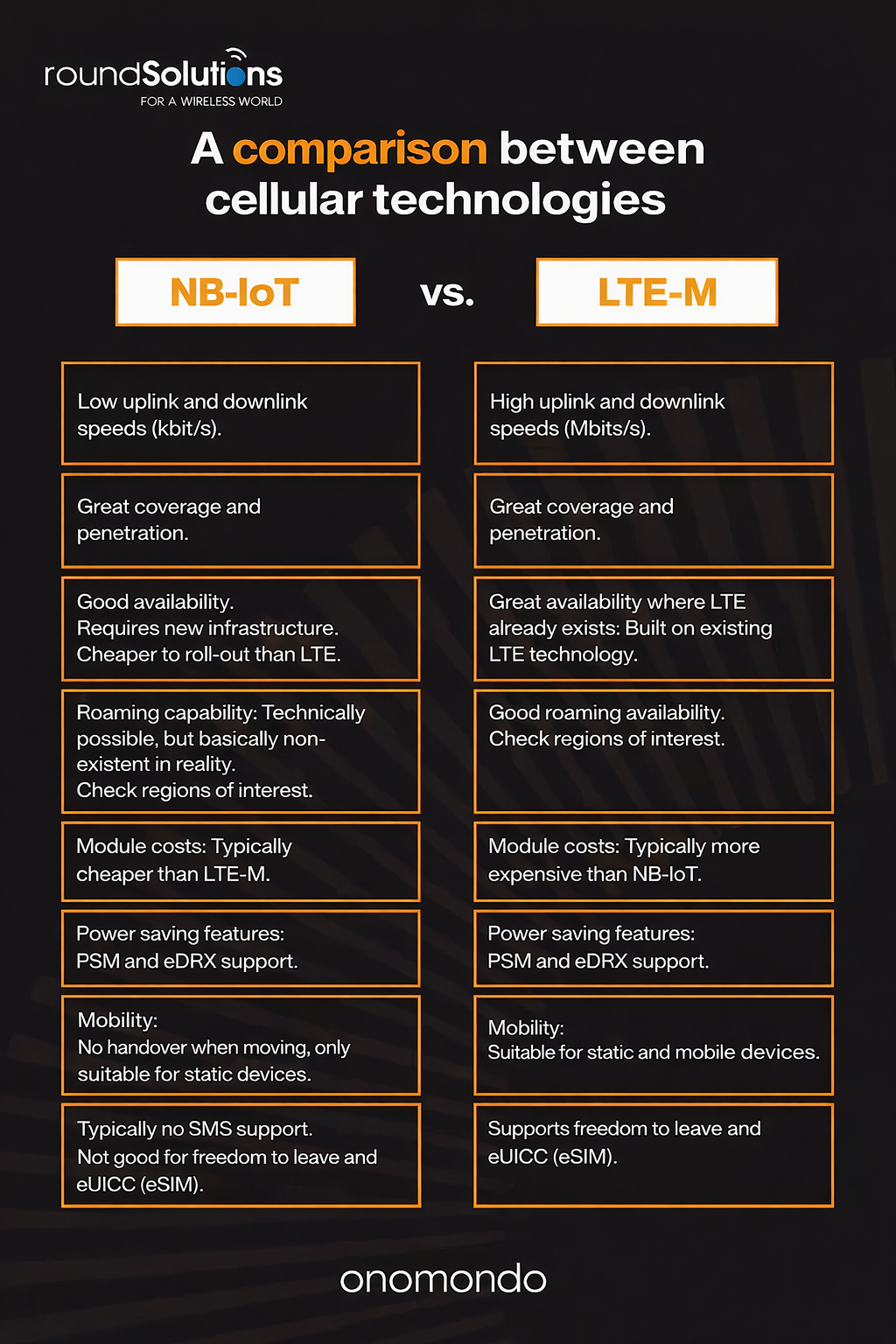
Industrial IoT devices rely on stable and efficient wireless connectivity. Choosing the right cellular technology is therefore an important step when designing connected devices. The most commonly used technologies for IoT deployments today are LTE, NB-IoT, and LTE-M, each designed for different application requirements.
LTE (Long Term Evolution) provides high data rates and reliable connectivity. It is typically used in devices that need to transmit larger amounts of data or stay continuously connected to the network. Examples include industrial IoT gateways, video monitoring systems, and transportation routers where stable and fast communication is required.
NB-IoT (Narrowband IoT) is optimized for low-power devices that transmit small amounts of data at long intervals. It offers excellent coverage and strong signal penetration, even inside buildings or underground installations. Typical applications include smart electricity meters, water meters, parking sensors, and environmental monitoring systems. Because NB-IoT focuses on energy efficiency, many devices can operate for several years on a single battery.
LTE-M (LTE Cat-M1) offers a balance between LTE and NB-IoT. It provides higher data rates than NB-IoT while maintaining relatively low power consumption. LTE-M also supports device mobility, which allows devices to move between cellular cells without losing connection. This makes LTE-M suitable for asset tracking systems, logistics monitoring devices, wearable IoT devices, and fleet management solutions.
When selecting a cellular technology, several factors should be considered. These include data transmission requirements, device mobility, power consumption, and installation environment. For example, a stationary sensor sending small status updates once per hour may benefit from NB-IoT, while a mobile tracking device installed in a vehicle may require LTE-M. Devices that need higher bandwidth or continuous connectivity typically rely on LTE.
At RoundSolutions, engineers work with a wide range of cellular technologies including LTE, LTE-M, and NB-IoT to support industrial IoT deployments. By combining cellular modules, optimized antenna solutions, and engineering expertise, RoundSolutions helps companies design reliable and scalable IoT systems for applications such as smart metering, industrial monitoring, logistics tracking, and smart city infrastructure.
Understanding the strengths and limitations of each connectivity technology is essential when designing robust IoT devices. Selecting the right technology early in the development process can significantly improve system reliability, energy efficiency, and long-term performance.