
Founded 1999 in Germany, Round Solutions is one of the leading pioneers in M2M and IoT technologies. We design, build and distribute the world's most advanced Edge and wireless technologies.

RoundSolutions © 2025 For A Wireless World


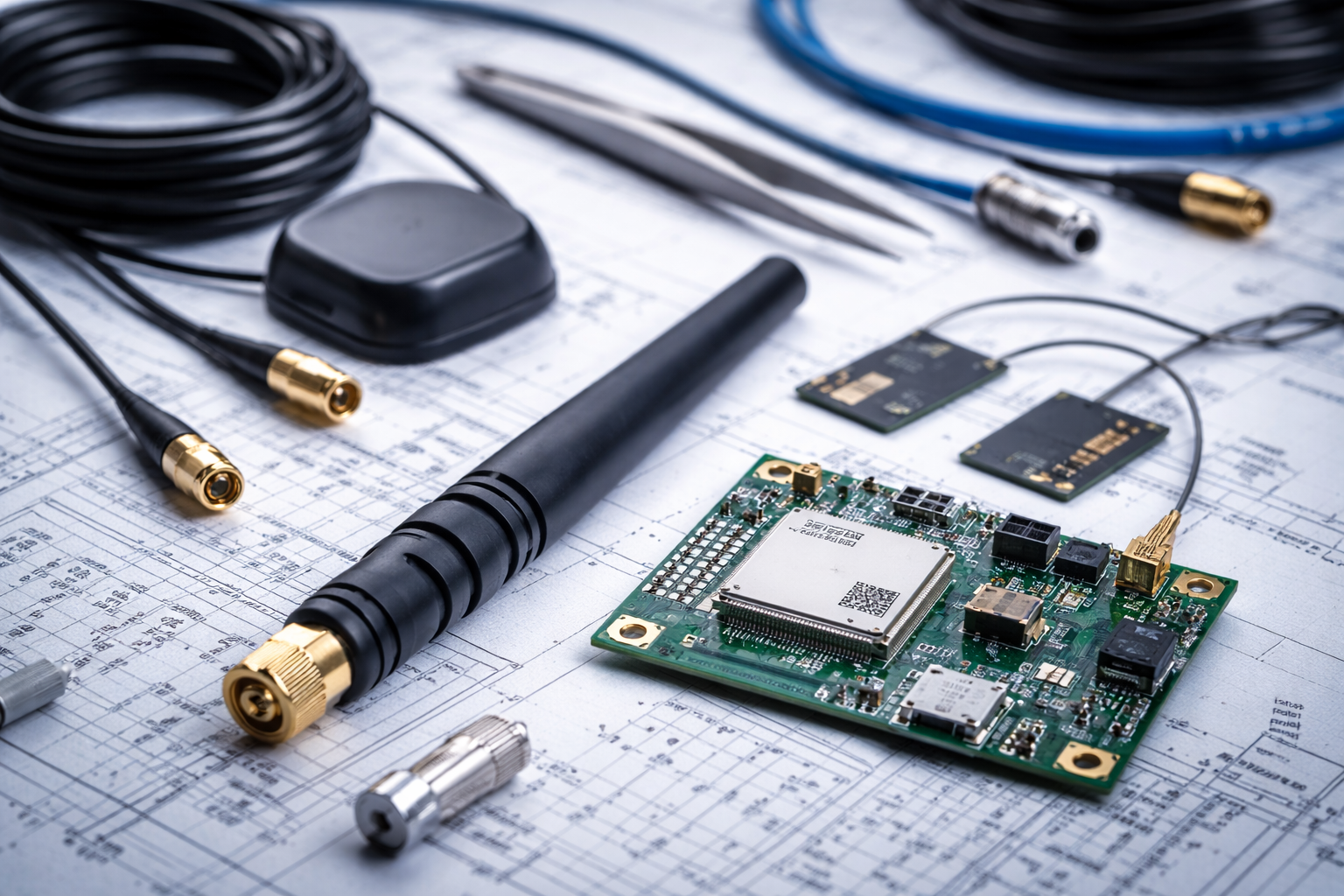
Industrial IoT devices depend on reliable wireless connectivity. In many projects the modem or module works perfectly, but the device still suffers from weak signal, unstable connections, or poor data throughput. In most cases the real issue is not the modem — it is the antenna setup.
Choosing the right antenna is therefore one of the most important steps when designing an Industrial IoT device.
The antenna is the component that physically connects the device to the wireless network. Even the best LTE or 5G modem cannot perform well if the antenna is poorly selected or installed incorrectly.
Common problems caused by wrong antenna selection include:
In industrial environments such as factories, basements, or metal cabinets, these issues become even more critical.
One of the first decisions engineers need to make is whether to use an internal or external antenna.
Internal antennas are integrated inside the device enclosure. They allow compact designs and eliminate external cabling. However, their performance is strongly influenced by the device housing, nearby electronics, and the available ground plane.
External antennas are mounted outside the enclosure and connected via a cable. They typically provide better performance, especially in environments where signal conditions are challenging.
For industrial applications, external antennas are often preferred because they allow optimal placement and improved signal reception.
Another critical factor is the supported frequency range.
Industrial IoT devices commonly operate on technologies such as:
The antenna must support all frequency bands required by the modem and network operator. Using a narrowband antenna on a multiband modem can significantly reduce connectivity performance.
Wideband antennas are therefore often the best choice for global deployments.
Even the best antenna will perform poorly if it is installed incorrectly.
Several factors influence antenna performance:
Ground plane
Many antennas require a metal ground plane to operate efficiently.
Distance from electronics
High-speed digital circuits and power components can create electromagnetic noise.
Cable losses
Long RF cables can reduce signal strength.
Orientation
The direction and polarization of the antenna affect signal reception.
In industrial installations, antenna placement should always be tested and validated.
During Industrial IoT deployments, engineers often encounter recurring antenna issues.
Typical mistakes include:
Avoiding these mistakes early in the design phase can significantly improve device performance.
Selecting the right antenna is only one part of building reliable Industrial IoT devices. Modem configuration, network compatibility, and device design also play an important role.
RoundSolutions supports customers with engineering services including:
With the right hardware and engineering expertise, Industrial IoT devices can achieve stable and efficient wireless connectivity even in challenging environments.